
Smarter Storage for High-Value Mining Scrap
High-value mining scrap can become much easier to assess when it is organised properly from the moment it comes out of service.
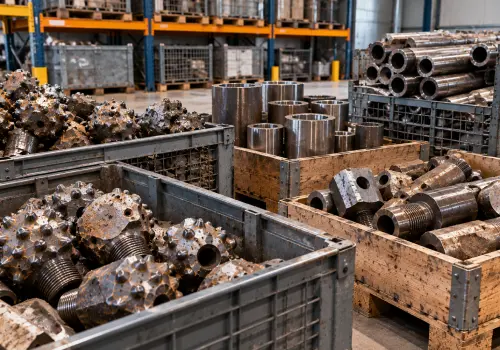
Across mining and drilling operations, worn tooling, tungsten-bearing components, carbide pieces and other valuable industrial materials may accumulate gradually. When everything ends up in the same scrap bin or storage area, useful information about the material can be lost. A more structured approach to mining scrap storage can make material easier to identify, inspect and prepare when the time comes to have it assessed.
Why Scrap Organisation Matters on Mine Sites
Mining operations naturally generate worn and surplus material through maintenance, equipment replacement and drilling activities.
Some material may look like ordinary steel at first glance while containing tungsten carbide or other higher-value components. Other items may already be separated, while complete tools can still contain recoverable material.
That distinction matters.
Tungsten & Superalloy Recyclers purchases material in several conditions, including clean, mixed, used and unprocessed forms. The company can also consider complete equipment containing tungsten rather than requiring every carbide component to be removed beforehand.
Good storage is therefore not about making every item perfectly clean or fully processed. It is about keeping useful material categories understandable enough for an informed assessment.
Separate Materials While Their History Is Clear
One of the simplest improvements is to separate material when it is removed from service rather than months later.
Maintenance and drilling crews often know what an item is when they handle it. That knowledge can become harder to recover after worn parts from several machines, contractors or work areas have accumulated together.
Practical categories might include:
- complete worn drilling tools
- loose or separated carbide pieces
- drill rods
- cutters and reamers
- tungsten-bearing wear components
- industrial residues or sludge
- known specialty-alloy material
- material requiring further identification
The exact categories will vary between operations. The important point is consistency.
Clear segregation can reduce uncertainty without requiring site teams to make technical claims about grades or composition they cannot verify.
Keep Identification Information With the Material
Labels and records can add useful context to a scrap stockpile.
Where information is genuinely known, a simple record might identify the equipment type, work area, source, approximate quantity or known material specification. Manufacturer markings, part numbers or existing material documentation may also be worth retaining rather than discarding immediately.
Avoid guessing.
If a grade, alloy or composition is unknown, recording it as unknown is better than assigning an inaccurate description. Material assessment should determine what can actually be confirmed.
This is particularly useful when stock is accumulated over longer periods or when different teams contribute material to the same storage area.
Protect Segregated Material From Becoming Mixed Again
Sorting material once is only useful if the storage system keeps it sorted.
Dedicated stillages, bins, drums, pallets or clearly designated storage areas can help operations maintain separation according to their own site requirements. Containers should be appropriate for the material being held and handled in accordance with the operation’s safety and environmental procedures.
For Western Australian sites, local conditions are also worth considering.
The Pilbara can experience severe weather, including damaging winds, heavy rainfall and flooding associated with tropical cyclones. The Bureau of Meteorology identifies 1 November to 30 April as the official Australian tropical cyclone season, and historical Pilbara events show that heavy rainfall and flooding can affect inland areas as well as the coast.
For outdoor mine site scrap management, that makes sensible containment and secure storage particularly important. Site-specific cyclone, drainage, environmental and safety procedures should always take priority.
Avoid Treating Every Scrap Stream the Same
Visual similarity does not necessarily mean two materials should be grouped together.
For example, separated tungsten carbide and a complete steel-bodied drill bit containing carbide are not the same material form. Tungsten & Superalloy Recyclers confirms that both can be purchased, but they may be valued differently.
Likewise, assessment can depend on several characteristics, including:
- composition
- tungsten content
- condition
- grade
- quantity
Keeping recognisably different material streams apart gives the buyer a clearer starting point when those factors need to be considered.
It can also prevent a relatively straightforward batch from becoming more difficult to assess because unrelated material has been added to it.
Create a Routine Instead of a Cleanup Project
The most practical scrap-management systems are usually ongoing routines rather than occasional cleanups.
A mine or drilling operation could establish a designated point where relevant worn material is placed after removal from service. From there, responsible personnel can keep categories organised and maintain whatever basic records the business finds useful.
The process does not need to become complicated.
A workable routine might simply involve identifying the material stream, placing it in the correct storage location and retaining known information until enough material has accumulated for assessment.
That approach can be especially useful for remote operations where worn tools and components are generated repeatedly over time.
Tungsten & Superalloy Recyclers has confirmed purchasing capability from remote mine sites, drilling operations and industrial facilities, with operational coverage that includes Perth, the Pilbara, the Goldfields and other confirmed Australian regions.
Better Organisation Creates Better Information
Good mining scrap storage is ultimately about knowing what you have.
Separating materials does not guarantee a particular price, and site teams should not be expected to identify every alloy or tungsten-bearing component themselves. What good organisation can do is preserve useful distinctions and information until a specialist assessment takes place.
For mining companies and drilling contractors, that can turn a mixed accumulation of worn equipment into a much clearer inventory of potentially valuable material.
Have High-Value Material Ready for Assessment?
If your operation has accumulated tungsten-bearing tools, drilling equipment, carbide, wear components or other high-value industrial material, Tungsten & Superalloy Recyclers can assess eligible material in clean, mixed, used or unprocessed forms.
With a main Australian yard in Malaga and confirmed purchasing coverage extending through the Pilbara, Goldfields and wider Australia, the team can discuss what you have and the most appropriate next step. Organising the material first can make that conversation simpler, clearer and more useful.