
A Better Handover for Surplus Industrial Materials
A clear material handover can make the first conversation with a specialist buyer far more useful, even when you do not know exactly what every item is.
Manufacturers, workshops, engineering businesses and industrial operations often accumulate surplus metals, worn components and valuable production materials over time. When that material is ready for assessment, a little preparation can help communicate what is available without requiring your team to become metallurgy experts.
The goal of a good industrial scrap handover is simple: provide accurate information you already have, preserve useful records and avoid guessing about anything you do not know.
Start With What You Actually Know
Before contacting a buyer, gather the basic information that is already available within your business.
That might include:
- the type of component or material
- where it came from
- whether it is clean, mixed or attached to other material
- known grade or specification
- approximate quantity
- condition of the material
- manufacturer markings or part numbers
- photographs of the material
Not every business will have all of this information, and that is fine.
If the material grade is unknown, say it is unknown. If you are unsure whether a component contains tungsten, nickel or another valuable metal, avoid making an assumption simply to complete the description.
Accurate uncertainty is more useful than an incorrect answer.
Take Useful Photos Before Making Enquiries
Photographs are one of the easiest ways to give a buyer an initial understanding of what you have.
A useful set of photos can show the overall batch as well as individual items or identifying features. Where relevant, include visible labels, markings, inserts, attached steel or other characteristics that may help distinguish one material form from another.
Try to photograph the material in reasonable lighting and from more than one angle when necessary.
For a larger stockpile, an overview photo can help communicate scale, while closer images provide more detail about the individual components.
Photos do not replace a proper assessment, but they can make the first discussion more productive.
Keep Known Grades and Records With the Material
Industrial businesses sometimes already possess useful information without realising how valuable it can be during an assessment.
Purchase records, equipment specifications, manufacturer documentation, stock codes or internal inventory descriptions may provide context about the material’s original purpose or known grade.
If that information is reliable, keep it associated with the relevant batch.
This can be particularly useful when dealing with specialty metals and alloys because two pieces of industrial material that look similar may not have the same composition.
Tungsten & Superalloy Recyclers purchases confirmed categories including tungsten, tungsten carbide, nickel, Inconel, titanium and other high-value specialty alloys, while specific grades are not assumed unless they are actually known or confirmed.
Give an Honest Picture of Material Condition
Condition can be relevant when material is assessed, so describe it as it actually exists.
For example, material may be:
- clean and separated
- mixed with other components
- used or worn
- attached to steel
- unprocessed
- stored as industrial surplus
- present as residue or sludge
The business is confirmed to consider material in multiple forms, including clean, mixed, used and unprocessed material. Complete equipment containing tungsten and separated tungsten carbide can also be considered.
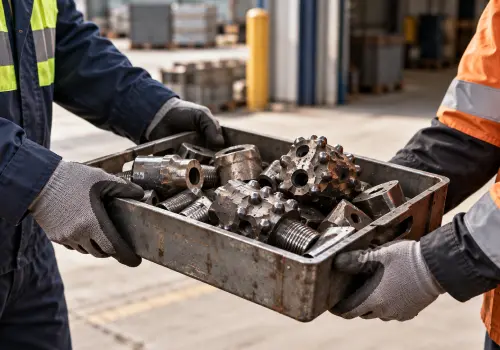
That means suppliers should not assume everything must be dismantled or cleaned before an initial enquiry.
Instead, show the buyer what you actually have.
Provide a Realistic Quantity Estimate
Quantity is another useful part of an industrial scrap handover.
An exact certified weight may not always be available before assessment, but an approximate quantity can still provide context. Depending on the material, that might be expressed as an estimated weight, number of pieces, number of containers or general batch size.
Avoid presenting an estimate as a confirmed measurement.
If you know that a pallet contains approximately a certain amount of material, describe it as approximate. If no reliable estimate is available, provide photographs and explain the scale as clearly as possible.
Quantity is one of the confirmed factors that can influence material value, together with composition, tungsten content, condition and grade.
Keep Different Material Streams Distinct
If several types of industrial surplus are being assessed at the same time, keeping them separate can make the handover clearer.
For example, clean tungsten carbide should not automatically be described as the same material as complete steel-bodied tooling containing carbide. Likewise, known nickel-based alloy material should not be mixed into an unidentified metal batch if it can reasonably be kept separate.
Good segregation does not require perfect technical identification.
It simply means preserving meaningful differences where they are already known.
This can help the buyer understand which materials need individual assessment and which may belong together.
Avoid Focusing Only on a Price Per Kilogram
It is natural to want to know what valuable industrial material is worth, but a reliable assessment usually needs more context than a material name alone.
Permanent online price figures can be misleading because material characteristics and market conditions can vary.
For Tungsten & Superalloy Recyclers, confirmed valuation factors include:
- composition
- tungsten content
- condition
- grade
- quantity
The site’s broader strategy therefore treats material value as an assessment question rather than presenting a generic permanent price-per-kilogram figure.
Preparing better information helps move that discussion from “What is scrap worth?” toward the more useful question: “What exactly is in this batch?”
Make the First Conversation Easier
A good handover does not need an elaborate reporting system.
For many businesses, a short material description, several clear photographs, an approximate quantity and any reliable identification records can provide a useful starting point.
The important principles are consistency and accuracy.
Share what is known. Keep material categories understandable. Preserve useful records. Avoid unsupported guesses about grades or composition.
That gives both sides a clearer basis for the next step.
Ready to Discuss Your Surplus Material?
If your Perth or Western Australian operation has tungsten-bearing material, carbide, nickel, Inconel, titanium or other high-value industrial surplus, Tungsten & Superalloy Recyclers can discuss the material you have and whether it falls within its purchasing scope.
The business’s main Australian yard is in Malaga, Perth, with confirmed purchasing coverage extending across Western Australia and other Australian regions.
Start with the information you already have—clear photos, known material details and an approximate quantity can make the initial assessment conversation much more useful.